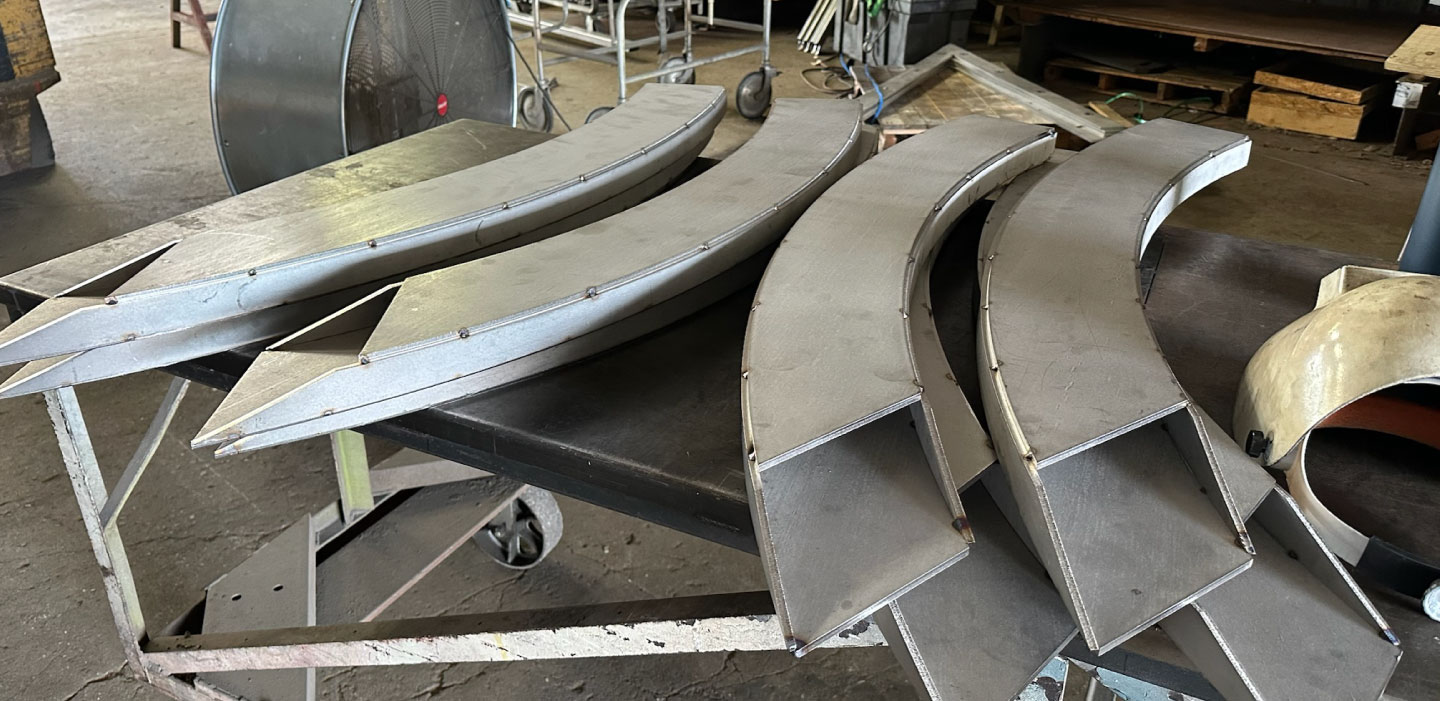
For OEMs and industrial manufacturers, sourcing a welded assembly can involve far more than finding a supplier capable of making a strong weld. The components may first need to be engineered, laser cut, formed, machined, fixtured, welded, finished, and inspected before they are ready for installation.
That makes custom fabrication and welding an interconnected manufacturing process. Decisions made during cutting and forming affect fit-up at the welding station, while welding processes can influence dimensions, appearance, and final assembly.
Understanding how these processes work together can help manufacturing engineers design better parts and help purchasing and supply chain teams evaluate fabrication partners more effectively.
What Does Custom Fabrication and Welding Include?
Custom fabrication and welding turns raw metal into components and complete assemblies built around application-specific requirements. Unlike off-the-shelf metal products, fabricated parts are produced according to customer drawings, CAD models, performance requirements, or other specifications.
A typical project may involve:
- Design and engineering support
- Laser cutting or CNC punching
- Press brake forming
- Machining
- MIG or TIG welding
- Hardware insertion
- Grinding and finishing
- Mechanical assembly
- Quality inspection
The exact combination depends on the component. A simple bracket may only require cutting and forming, while an equipment frame or complex weldment could move through several processes before completion.
Understanding the complete sheet metal manufacturing process can help engineers anticipate how decisions at one stage influence downstream operations.
Why Fabrication and Welding Should Be Planned Together
Welding cannot compensate for poorly fabricated components. If cut features are misplaced, bends are inconsistent, or mating components do not fit correctly, welding becomes more difficult and the risk of dimensional variation increases.
For this reason, cutting, forming, and welding should be considered as parts of one manufacturing strategy.
For example, accurate laser cutting and precision bending can improve component fit-up before welding begins. Better fit-up helps maintain joint consistency and reduces the amount of adjustment required during assembly.
Engineers can also use formed geometry to eliminate unnecessary welded joints. A component that previously required three separate pieces, for instance, may be redesigned as one formed part plus one welded connection.
Reducing unnecessary joints can lower fabrication time, simplify fixturing, and create a more efficient production process.
Choosing the Right Welding Process
Custom fabrication projects commonly rely on several welding methods, with process selection driven by material, thickness, joint configuration, appearance, and production requirements.
MIG Welding
MIG welding is commonly used for steel structures, frames, equipment components, and production weldments. Its relatively high deposition rate makes it well suited to applications where production efficiency and strong, repeatable joints are priorities.
TIG Welding
TIG welding provides precise heat and weld-puddle control, making it useful for thinner materials, stainless steel, aluminum, and applications where weld appearance matters.
The best process ultimately depends on the component. Material thickness, accessibility, distortion risk, joint geometry, and end-use requirements should all be evaluated before welding begins.
Managing Weld Distortion and Dimensional Accuracy
One of the more technical challenges in custom fabrication and welding is managing heat.
Welding creates localized heating and cooling that can cause metal to expand and contract. If this behavior is not accounted for, the finished assembly can experience warping or dimensional changes.
Several factors can influence distortion, including:
- Material type and thickness
- Weld size and length
- Joint configuration
- Heat input
- Weld sequence
- Fixture design
- Overall assembly geometry
Fabricators can control these variables through appropriate fixturing, balanced weld sequences, controlled heat input, and designs that minimize unnecessary welding.
Dimensional requirements should also reflect the complete manufacturing process, including how cutting, bending, welding, and material characteristics can affect achievable tolerances throughout fabrication.
Design for Manufacturability Starts Before the First Cut
Some of the biggest opportunities to improve a welded assembly occur during design.
Engineers should consider whether parts provide adequate welding access, whether bends can replace welded seams, and whether tolerances are appropriate for the fabrication method.
Other important considerations include:
- Maintaining appropriate bend radii
- Providing sufficient clearance around holes and cutouts
- Designing joints for reliable fit-up
- Limiting unnecessarily tight tolerances
- Providing access for welding and inspection
- Accounting for finishing requirements
Following practical sheet metal design guidelines early can reduce redesigns, simplify production, and improve repeatability once a part moves into ongoing manufacturing.
Applications for Custom Fabrication and Welding
Custom fabrication and welding supports applications ranging from individual components to large, multi-part assemblies.
Industrial equipment manufacturers may require machine bases, guards, frames, housings, and structural weldments that must align accurately with mechanical systems.
Agricultural equipment manufacturers often need durable brackets, supports, frames, and assemblies designed for vibration, impact, outdoor exposure, and demanding field conditions.
Heavy equipment manufacturers may source structural components and welded assemblies where strength, repeatability, and consistent production quality are essential.
The same capabilities support material handling systems, specialty vehicles, electrical equipment, processing machinery, and other OEM products. In each case, fabrication decisions should reflect the component’s loads, environment, assembly requirements, and expected service life.
Why Integrated Fabrication Matters to OEM Supply Chains
For purchasing and supply chain teams, the way a part is sourced can be almost as important as the way it is manufactured.
Sending cut parts to one vendor, formed components to another, and welding to a third introduces additional transportation, scheduling, communication, and quality handoffs.
An integrated fabrication workflow can reduce those touchpoints. It can also provide clearer accountability when drawings change, schedules tighten, or a production issue needs to be resolved.
When evaluating a custom fabrication and welding supplier, consider its ability to support:
- Engineering and manufacturability reviews
- Precision cutting and forming
- Multiple welding processes
- Complex weldments and assemblies
- Quality inspection
- Prototype and production quantities
- Repeat manufacturing programs
The goal is not simply to find a welding vendor. It is to identify a manufacturing resource capable of managing the complete component from raw material through finished assembly.
Put Your Next Fabrication Project in Experienced Hands
Budde Sheet Metal Works provides custom sheet metal fabrication backed by more than a century of fabrication experience. Budde combines design and engineering, CNC cutting and forming, MIG, TIG, and spot welding, assembly, and quality inspection to help manufacturers move complex parts and weldments from concept through production.
Whether you need a one-off custom assembly or repeat production components, contact our team to request a quote and discuss your custom fabrication and welding requirements.