
Laser Etching Built for Precision and Traceability
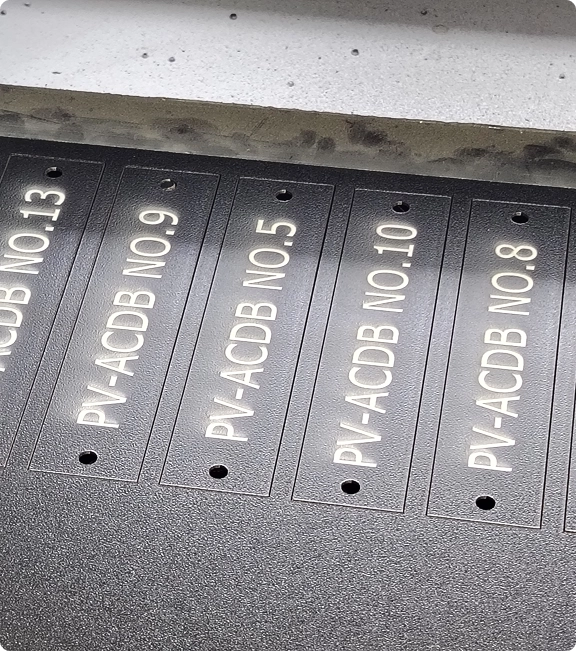
Laser etching uses a focused laser beam to create permanent, high-contrast marks on the surface of a part. Because the process is digitally controlled and requires no physical contact with the workpiece, it can produce detailed, repeatable markings without traditional labels, inks, or mechanical engraving.
Using our TRUMPF TruMark 7000, Budde provides laser marking and etching for components requiring identification, traceability, instructions, branding, or other customized marks.
Budde’s laser etching capabilities help manufacturers:
01
Add permanent part identification
02
Create readable barcodes and data matrix codes
03
Apply sequential part and serial numbers
04
Reproduce detailed diagrams, graphics, and images
05
Mark flat and round components
06
Integrate identification into the fabrication process
Why Use Laser Etching?
Permanent Part Identification
Laser-etched information becomes part of the component’s surface rather than relying on an applied label or printed marking. This makes laser etching well suited for parts requiring durable identification throughout manufacturing, assembly, and use.
Detailed, Repeatable Marks
Computer-controlled laser processing can reproduce detailed text, numbers, codes, diagrams, and graphics consistently from part to part—an important advantage for repeat production.
No Physical Tool Contact
Unlike stamping or mechanical engraving, laser marking doesn’t require a cutting tool to physically contact the workpiece. This helps minimize mechanical stress on the component while allowing detailed marks to be created on a variety of part geometries.
Flexible Digital Marking
Because marking information is digitally controlled, Budde can accommodate applications ranging from a company logo to sequential part numbers and machine-readable codes.
Integrated With Your Fabrication Process
Part identification shouldn’t become another production bottleneck. With marking and fabrication capabilities under one roof, Budde can incorporate laser etching into a broader manufacturing workflow and reduce unnecessary supplier handoffs.
Our Laser Marking & Etching Capabilities
Whether you need functional identification, traceability information, or a customized visual mark, Budde’s equipment gives manufacturers flexibility to incorporate marking directly into their parts.
| Application | How Laser Etching Can Be Used |
|---|---|
| Sequential Part Numbers | Apply unique or sequential identification to individual components |
| Data Matrix Codes | Create compact, machine-readable codes for identification and traceability |
| Barcodes | Add scannable information directly to a component |
| Diagrams | Permanently mark reference information, instructions, or technical graphics |
| Photos & Graphics | Reproduce detailed visual elements or customized imagery |
| Branding | Add logos and other permanent brand identification |
| Round Parts | Apply marks to cylindrical or round components |
Actual achievable tolerances and cutting capabilities depend on material, thickness, geometry, feature size, and other part requirements. Contact Budde to review your application.
Materials We
Laser Mark & Etch
Budde’s laser marking and etching capabilities support a variety of materials, including:
Budde can review the material, surface, and marking requirements to determine the right approach for your application.
Aluminum
A common choice for lightweight fabricated components, equipment, housings, and other applications requiring permanent identification.
Stainless Steel
Well suited for parts requiring corrosion resistance along with permanent identification, traceability, or branding.
Steel
Laser etching can add part numbers, codes, instructions, and other identifying information to a wide variety of fabricated steel components.
Plastics
Compatible plastics can be laser marked for identification, labeling, and other application-specific requirements.
Exotic Materials
Budde can also accommodate specialized materials for applications requiring more than standard steel, stainless, or aluminum.
Designing Parts
for Laser Etching
Providing the right information during the RFQ stage helps Budde determine the appropriate marking process and avoid unnecessary revisions later.
When specifying laser etching, consider:
Mark Location
Clearly identify where the mark should appear on the finished component. If the part will also be formed, welded, or assembled, consider whether later operations could obscure or affect the marked area.
Mark Content
Specify exactly what the mark needs to contain, whether that’s a logo, serial number, barcode, data matrix, diagram, text, or other information.
Variable Information
If serial numbers, sequential part numbers, or other information changes from component to component, identify the required numbering or data convention in the RFQ.
Mark Size and Legibility
Text and machine-readable codes need enough space to remain legible for their intended use. Required mark size may depend on the amount of information, material, and surface condition.
Part Geometry
Flat surfaces generally provide straightforward access, but Budde can also accommodate round parts. Providing a 3D model or drawing helps our team evaluate access to the specified marking area.
Surface and Finish Requirements
Surface condition can affect the appearance and contrast of a laser mark. If the part has specific cosmetic or finishing requirements, include them with your project documentation.
More Than a Laser
Etching Supplier
Whether your parts need sequential identification, machine-readable codes, permanent instructions, branding, or another customized mark, we’ll help determine how laser etching fits into the complete manufacturing process.
Send us your drawings or CAD files along with your material, quantity, marking location, marking content, and any traceability or readability requirements for your project to get started.