
CNC Press Brake Forming Built for Accuracy and Repeatability
Budde operates multiple TRUMPF press brakes designed to provide flexibility, efficiency, and accuracy across a wide range of forming applications.
Our CNC press brake forming services help manufacturers:
01
Produce simple and complex bend geometries
02
Maintain consistency across repeat production runs
03
Form large components with up to a 161-inch bed length
04
Accommodate complex setups with multiple tool stations
05
Move efficiently from flat blanks to finished components
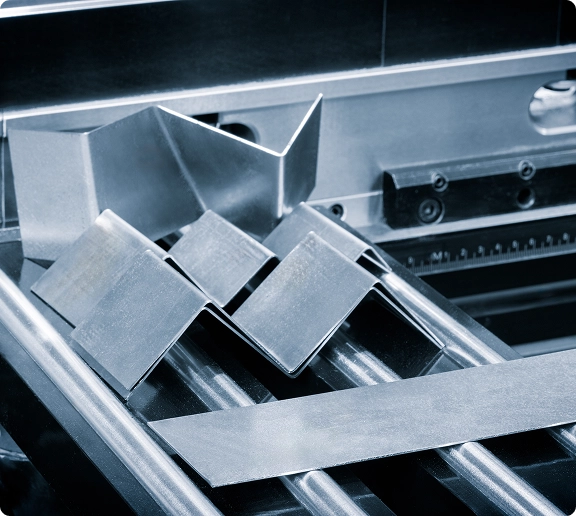
Why Use CNC Press
Brake Forming?
Complex Forming Capabilities
Budde’s press brakes feature 6-axis backgauges that allow multiple tool stations to be configured for complex forming operations using segmented-style tooling. This flexibility helps accommodate parts with multiple bends and more challenging geometries.
Repeatable Production
Once a complex forming setup is established, CNC controllers can save the configuration for future production. This helps maintain consistency from part to part and across repeat orders.
Precision Where It Matters
Accurate forming is critical when bends determine how parts fit, align, or assemble downstream. Budde combines CNC-controlled equipment with experienced operators to help maintain dimensional consistency throughout production.
Efficient Production
Budde operates the TRUMPF TruBend 7036, a high-speed bending system designed for efficient production. Faster forming cycles can help move components through fabrication without sacrificing the accuracy required for finished assemblies.
Integration With Downstream Fabrication
Forming is rarely the final operation. Budde can move formed components directly into welding, assembly, machining, inspection, and other processes without adding unnecessary supplier handoffs.
Our CNC Press Brake
Forming Capabilities
Budde combines multiple TRUMPF press brakes, advanced backgauge technology, segmented tooling, and CNC controls to handle applications ranging from straightforward bends to complex forming sequences.
Prototypes and New Product Development
Quickly turn CAD designs into physical parts for fit, function, and design validation.
Low-Volume and Custom Parts
Produce complex components without investing in dedicated profile tooling.
Repeat Production
Maintain consistent geometry across recurring orders and production runs.
Complex Fabricated Assemblies
Combine laser cutting with forming, welding, and assembly to simplify your supply chain.
| Capability | Budde CNC Press Brake Forming |
|---|---|
| Maximum Press Force | 250 tons |
| Maximum Bed Length | 161 in |
| Y-Axis Precision | 0.0008 in |
| X-Axis Precision | 0.0008 in |
| R-Axis Precision | 0.0008 in |
| Backgauge Capability | 6-axis |
| Tooling | Multiple tool stations with segmented-style tooling |
| Equipment Highlight | TRUMPF TruBend 7036 |
Actual forming capabilities and achievable tolerances depend on material, thickness, bend geometry, tooling, part size, and other project requirements. Contact Budde to review your application.
What We Form
Press brake forming is a versatile process that can create a wide range of sheet metal geometries and components.
Brackets and Supports
Create structural bends and mounting features while reducing the need for separate components or additional joining operations.
Channels and Profiles
Form flat blanks into channels and other profiles for structural, equipment, and enclosure applications.
Enclosures and Panels
Produce formed panels and enclosure components where bend position, flange dimensions, and final fit are critical to assembly.
Multi-Bend Components
Use controlled forming sequences to create parts with multiple bends, flanges, and more complex geometries.
Fabricated Assemblies
Form individual components that can move directly into welding and assembly for equipment frames, structural supports, machinery components, and other finished fabrications.
Designing Parts for
Press Brake Forming
Good sheet metal design can make forming more predictable, reduce special tooling requirements, and help prevent revisions during quoting.
When designing a press brake formed component, engineers should consider:
Bend Radius
The appropriate inside bend radius depends on material type, thickness, tooling, and forming method. Radii that are too tight can increase forming force or create a risk of cracking.
Minimum Flange Length
A flange must be long enough to engage the press brake tooling properly. As a general design guideline, a minimum flange length of approximately 4× material thickness is a useful starting point, although actual requirements depend on the die opening and tooling.
Holes and Features Near Bends
Holes, slots, and other features located too close to a bend line can distort as the material forms. Critical features should be positioned with the final bend geometry in mind.
Springback
Sheet metal naturally recovers slightly after forming. The amount of springback varies with material, thickness, bend radius, and other factors and must be considered when targeting a final bend angle.
Tool Access
Deep channels, boxes, return flanges, hems, and other complex geometries can interfere with the punch, die, or previously formed features.
Forming Sequence
On multi-bend components, the order of operations matters. An early bend can prevent tooling or backgauge access to a later bend, so the complete forming sequence should be considered before production begins.
More Than a Press
Brake Forming Supplier
We bring press brake forming together with engineering support, precision cutting, machining, welding, assembly, and inspection to help customers move from concept to completed components with fewer supplier handoffs.
Send us your drawings or CAD files along with your material, thickness, quantities, critical dimensions, and tolerance requirements. Our team can review your project for manufacturability and provide a competitive quote.