
TIG Welding Built for Control and Quality
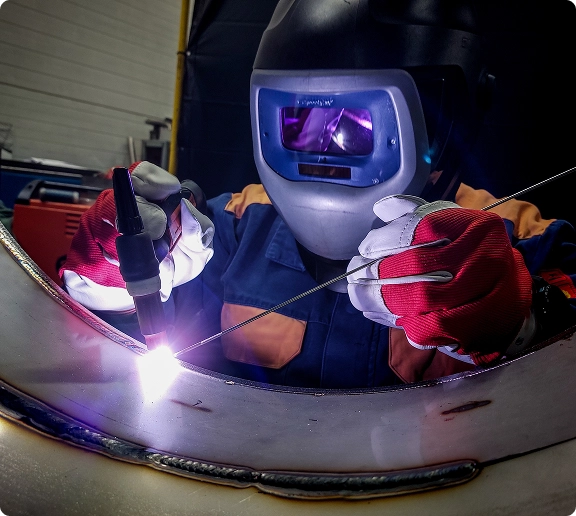
TIG welding—also known as Gas Tungsten Arc Welding (GTAW)—uses a non-consumable tungsten electrode to create a controlled weld. The process gives the welder precise control over heat input and filler material, making it especially useful for applications where weld quality and appearance are important.
Budde provides comprehensive welding capabilities for projects ranging from individual fabricated components to complete welded assemblies.
Our TIG welding services help manufacturers:
01
Produce clean, controlled welds
02
Weld thin and light-gauge materials
03
Join stainless steel, aluminum, and other metals
04
Support both custom and repeat-production requirements
05
Integrate welding with cutting, forming, machining, and assembly
Why Use TIG Welding?
Precise Heat Control
TIG welding gives the operator a high degree of control over the welding arc and heat input. This is especially valuable when working with thinner materials or components where excessive heat can contribute to distortion.
Clean, High-Quality Welds
TIG welding is known for producing clean, precise welds with a controlled appearance. That makes it well suited for fabricated components where weld quality or aesthetics are important to the finished product.
Versatility Across Materials
TIG welding can be used with a range of metals commonly found in fabricated products, including stainless steel, aluminum, and carbon steel.
Well Suited for Detailed Work
The control provided by TIG welding makes it a strong choice for detailed joints, smaller components, and complex assemblies where access, fit-up, or weld placement requires greater precision.
Integrated With Complete Fabrication
A good weld starts with accurately fabricated components. Budde can manage cutting, forming, machining, welding, and assembly under one roof, helping maintain consistency from individual parts through the completed weldment.
Our TIG Welding
Capabilities
Budde combines experienced welding professionals with comprehensive fabrication capabilities to support projects of varying size, complexity, and production requirements.
| Capability | Budde TIG Welding |
|---|---|
| Welding Process | TIG / Gas Tungsten Arc Welding (GTAW) |
| Project Range | Custom parts through complete welded assemblies |
| Material Range | Light-gauge material through larger fabricated components |
| Production Support | Custom, prototype, and repeat-production applications |
| Welding Location | In-shop or custom work at your facility |
| Additional Welding Capabilities | MIG and spot welding |
| Integrated Services | Laser cutting, press brake forming, machining, assembly, and inspection |
Actual welding requirements depend on material, thickness, joint geometry, accessibility, finish requirements, weld specifications, and the intended application. Contact Budde to review your application.
Materials for TIG Welding
TIG welding is compatible with several materials commonly used in custom metal fabrication.
Not sure which welding process makes sense for your material or assembly?
Budde can evaluate your design and recommend an approach based on the part requirements.
Stainless Steel
TIG welding is frequently used for stainless steel components where corrosion resistance, controlled heat input, and weld appearance are important.
Aluminum
Aluminum’s thermal properties can make welding more demanding. TIG welding provides the control needed for many aluminum components and fabricated assemblies.
Carbon Steel
TIG welding can also be used for steel parts when the application calls for precise, controlled welds.
Specialty Materials
Material grade, thickness, surface condition, and application requirements all influence welding performance. If your project uses a less common material, Budde can review the specification and determine the appropriate fabrication approach.
Designing Parts for
TIG Welding
Weld quality depends on more than the welding process itself. Material selection, joint design, fit-up, accessibility, and upstream fabrication all influence the finished assembly.
When designing a TIG-welded component, engineers should consider:
Joint Design and Fit-Up
Consistent gaps and properly aligned mating surfaces help create repeatable welds. Poor fit-up can increase welding time and make controlling the finished assembly more difficult.
Weld Accessibility
The welder needs sufficient access to position the torch and, when required, add filler material. Enclosed corners, narrow channels, and other restricted geometries can make otherwise straightforward welds more difficult.
Material Thickness
Very thin material requires careful heat control, while thicker sections may change joint preparation and welding requirements. Clearly specifying material and thickness during quoting helps determine the appropriate process.
Weld Size and Location
Specify where welds are functionally required rather than over-welding the assembly. Additional weld length can increase heat input, production time, and distortion without necessarily improving part performance.
Distortion
All fusion welding introduces heat. As the weld and surrounding material cool, thermal expansion and contraction can cause movement in the assembly. Joint placement, weld sequencing, fixturing, and overall part geometry should be considered when dimensional accuracy is critical.
Finish Requirements
If welds will remain visible or require grinding, blending, coating, or another finishing operation, identify those requirements on the drawing or RFQ.
Providing weld symbols, material specifications, critical dimensions, and applicable quality requirements upfront helps Budde quote the project accurately and plan the appropriate fabrication sequence.
More Than a TIG
Welding Supplier
Our welding capabilities are part of a complete fabrication operation built to support projects from early concepts and prototypes through repeat production and finished assemblies.
Send us your drawings or CAD files along with your material, thickness, quantities, weld requirements, critical dimensions, and finish expectations. Our team can review your project for manufacturability and provide a competitive quote.